Tupolev Tu-144
Public Joint Stock Company Tupolev
Details
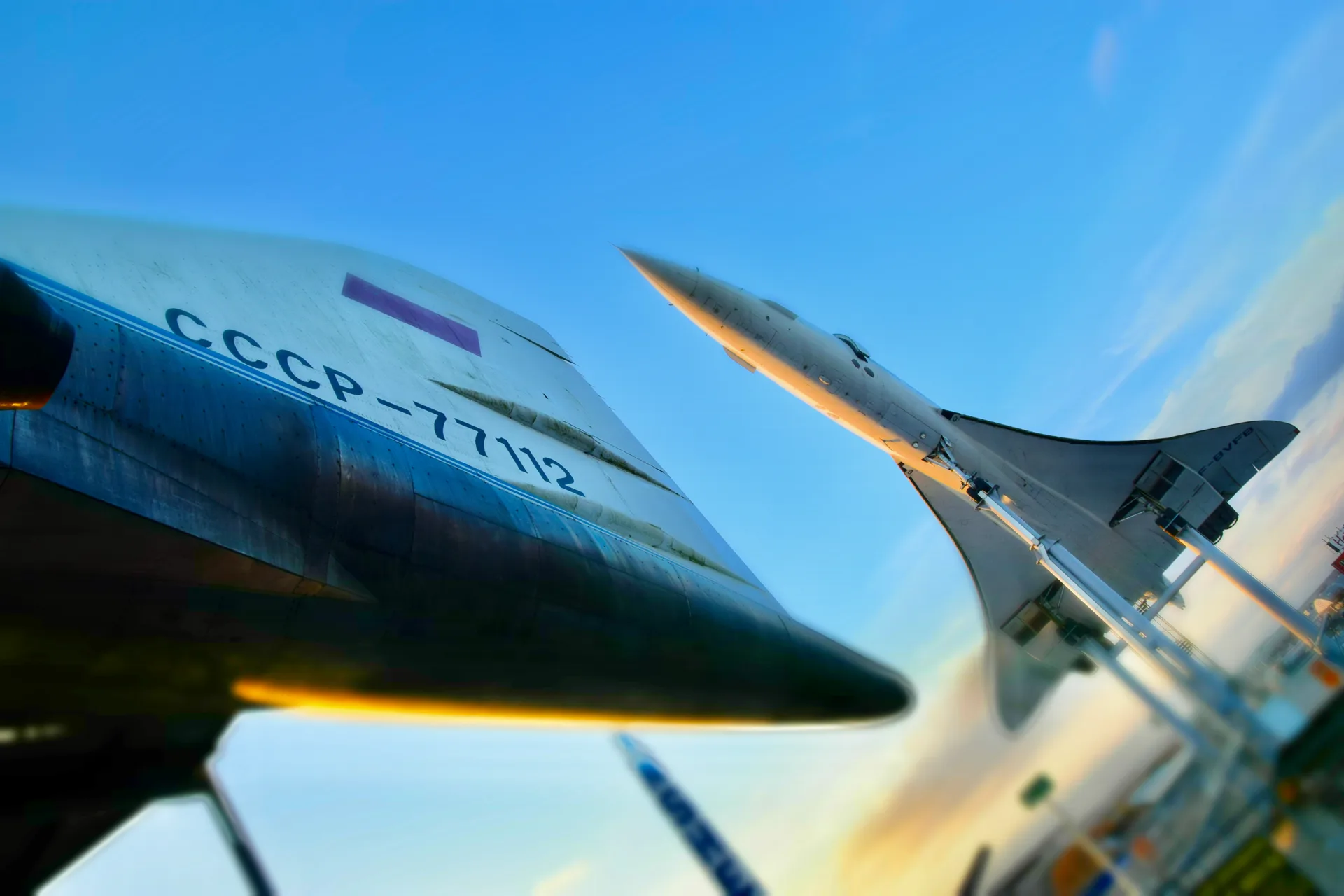
The Tupolev Tu-144 is the world's first commercial supersonic transport aircraft (SST) to fly, representing a remarkable achievement in Soviet aviation technology and Cold War-era competition with the Anglo-French Concorde. First flown on December 31, 1968 (two months before Concorde), and entering commercial service with Aeroflot on November 1, 1977, the Tu-144 was designed to transport passengers at speeds exceeding Mach 2 across intercontinental distances. The aircraft is characterized by its distinctive delta wing configuration with retractable canard foreplanes (deployed during takeoff and landing for improved lift and control), four powerful Kuznetsov NK-144 turbofan engines mounted in nacelles beneath the wing roots, distinctive "droop snoot" nose that lowered for improved pilot visibility during landing approaches, and elongated fuselage optimized for supersonic flight. The Tu-144 features a cruise speed of Mach 2.15 (2,300 km/h) at 59,000 feet altitude, maximum speed capabilities of Mach 2.35 (2,500 km/h), a passenger capacity of 98-140 depending on configuration (98 in two-class or 120-140 in single-class layout), and four Kuznetsov NK-144 afterburning turbofan engines producing a combined 784.56 kN total thrust. Variants include the prototype Tu-144 (initial design with ogival wing and NK-144 engines), production Tu-144S (standard production with enhanced systems), and Tu-144D (improved variant with more efficient Kolesov RD-36-51 engines and extended range). Despite its technical achievements, the Tu-144 faced significant challenges including high operating costs, limited range (3,510 nautical miles), excessive cabin noise levels making passenger conversation difficult, and reliability concerns that emerged during development and service. Commercial passenger service was short-lived, operating only from November 1977 to June 1978 primarily on the Moscow-Almaty route, with cargo service continuing until 1983. A total of 16 aircraft were built including prototypes before production ended in 1983. The Tu-144 later served NASA in the 1990s for supersonic research programs. While operational service was limited, the Tu-144 remains a significant milestone in aviation history as the first supersonic transport to fly and a testament to Soviet aerospace engineering capabilities during the Cold War era. NATO reporting name: "Charger".
Variants
Built
Weightscompared to Boeing 757-300
Capacitycompared to Boeing 757-300
Passenger Capacity
47% of 757-300 maximum capacity
Crew
Dimensions
Length
Wingspan
Height
Wing Area
Cabin Width
Engine Specifications
Engine Count
4×
Engine Model
Kuznetsov NK-144
Thrust per Engine
196.1 kN(44094 lbf)
Fuel & Cargo
Fuel Capacity
87,500 L
Cargo Volume
20 m³
Production & History
Total Produced
16
Production Status
Out of production
Manufacturing Period
1968–1983
First Flight
December 31, 1968
Entered Service
November 1, 1977
Business jets and the API are coming
If you came here for the Tupolev Tu-144, you are the reader those are being built for. Leave an address and you will hear when they are ready.