Boeing 707
Boeing Commercial Airplanes
Details
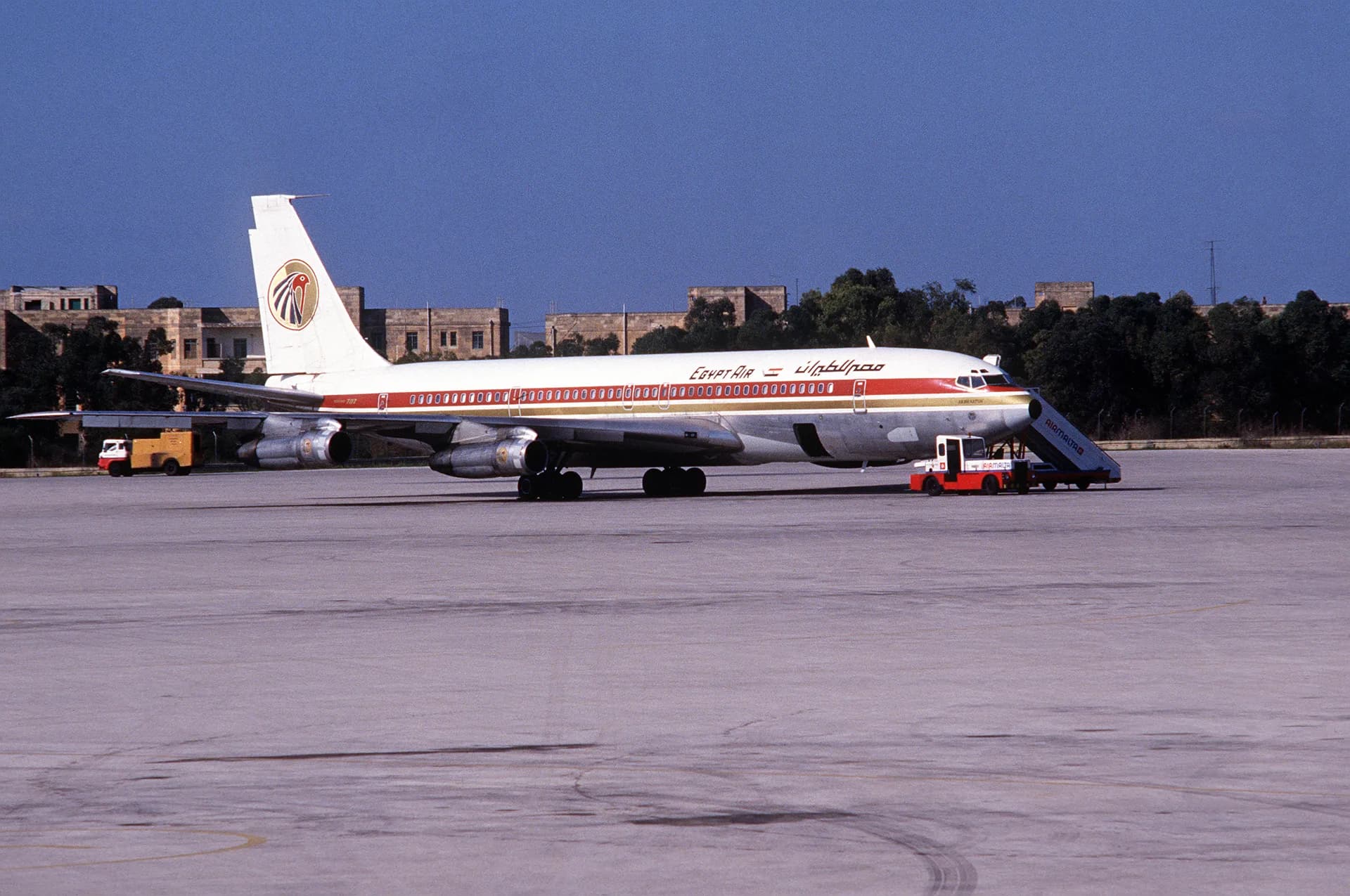
The Boeing 707 was the aeroplane that made jet travel ordinary, and the ancestor of every Boeing airliner that followed — the 720 and the 727 both reuse its fuselage cross-section. It grew out of the Model 367-80 prototype into four series: the domestic -100 and -200, and the intercontinental -300 and -400, which have a longer body, a greater wingspan and higher gross weights. The -320C was built both as a convertible passenger/cargo aeroplane and as a pure freighter. The cruise speed, cruise Mach, range, ceiling, climb rate and take-off distance are EUROCONTROL's figures for the B703 type code rather than a certificate's: a type certificate states limits and weights, not cruise performance, and the source does not distinguish sub-variants. Cabin width and height are Boeing's own, from Boeing D6-58322, 707 Airplane Characteristics for Airport Planning, section 2.5, page 19: interior trim to trim 139.3 in (354 cm), 86.3 in (219.2 cm) floor to ceiling.
Variants
Weightscompared to Boeing 757-300
Capacitycompared to Boeing 757-300
Passenger Capacity
66% of 757-300 maximum capacity
Dimensions
Length
Wingspan
Height
Cabin Width
Cabin Height
Engine Specifications
Engine Count
4×
Engine Model
Pratt & Whitney JT3D or JT4A; Rolls-Royce Conway RCo.12 on the -420
Fuel & Cargo
Fuel Capacity
90,290 L
Cargo Volume
48.36 m³
Production & History
Production Status
Out of production
First Flight
December 20, 1957
Business jets and the API are coming
If you came here for the Boeing 707, you are the reader those are being built for. Leave an address and you will hear when they are ready.