Tupolev Tu-214
Public Joint Stock Company Tupolev
About
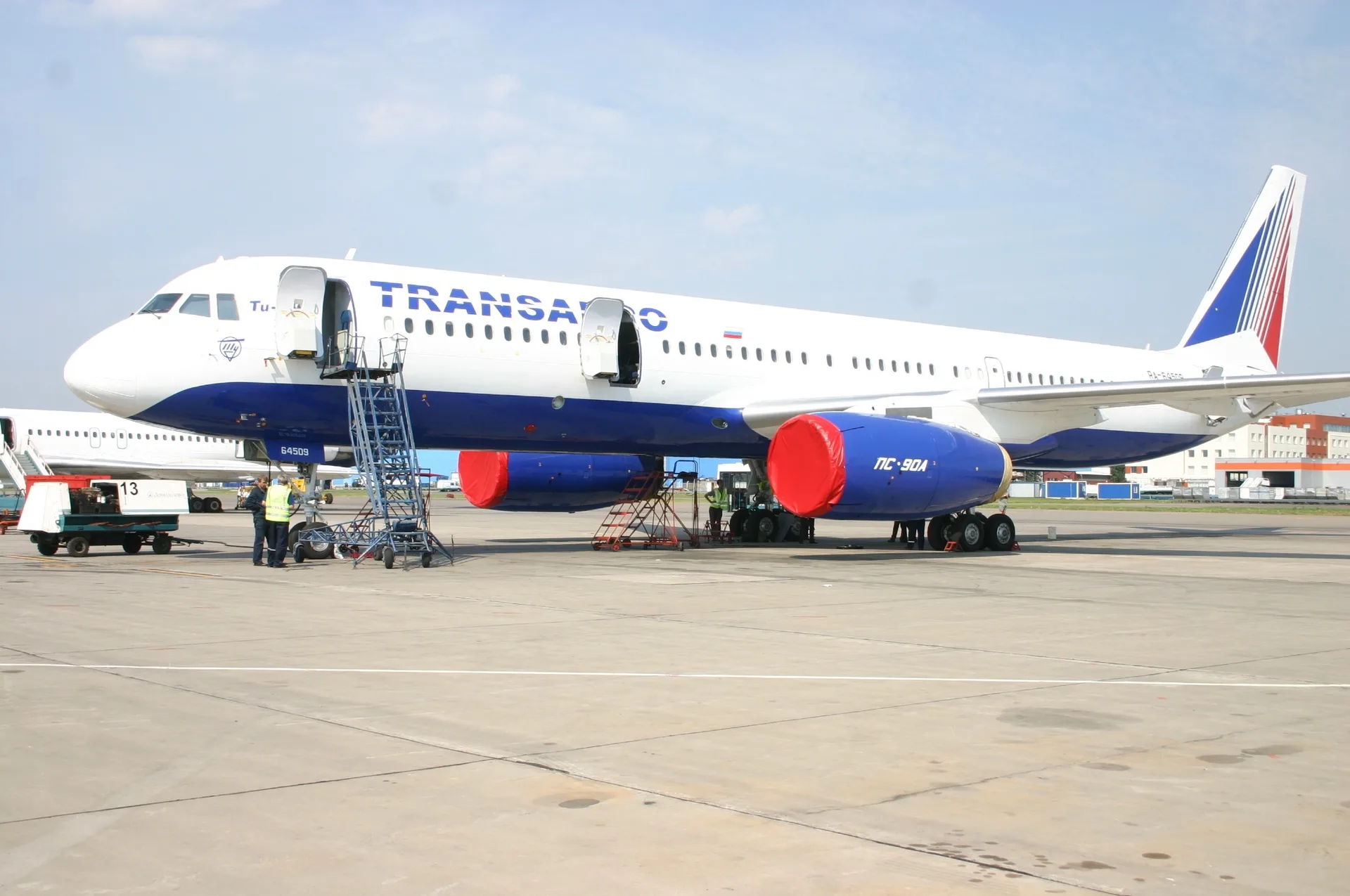
The Tupolev Tu-214 is the extended-range variant of the Tu-204 family, featuring increased maximum takeoff weight, enhanced fuel capacity with supplementary fuel tanks, and structural reinforcements designed for longer-range operations and specialized government/VIP missions. Designated Tu-214 when manufactured at the Kazan Aircraft Production Association (KAPO) starting in 1996, the variant represents an upgraded iteration of the Tu-204-100 with higher gross weight capabilities and extended operational range. The Tu-214 is technically a Tu-204-200 built at Kazan, with the key distinction being manufacturing location (Tu-204 from Aviastar-SP in Ulyanovsk, Tu-214 from KAPO in Kazan) and enhanced weight/fuel specifications. The defining features include two Aviadvigatel PS-90A high-bypass turbofan engines producing 156.9-158.3 kN (35,273-35,580 lbf) of thrust each with high bypass ratio for fuel efficiency and reduced noise, significantly increased maximum takeoff weight of 110,750 kg (110.75 tonnes, 244,160 lb) - the highest in the Tu-204 family enabling superior payload capacity and extended flight distances, additional supplementary fuel tanks in the center section providing enhanced fuel capacity and enabling practical range up to 7,200 km (3,887 nautical miles) with full passenger load or 3,800 km (2,052 nm) with maximum 25.2-tonne payload, and structural reinforcements including strengthened landing gear and airframe to support the higher operational weights. Manufacturing differences from the Tu-204 include door configuration (Tu-214 has three doors and one emergency door, while Tu-204 has two main doors and two emergency doors) and integration of updated systems and avionics during Kazan production. The Tu-214 accommodates up to 210 passengers maximum capacity in commercial configuration, though many examples serve in specialized government roles including VIP transport, communications relay, reconnaissance, and surveillance missions with customized interiors. Operational experience with DalAvia demonstrated significant fuel efficiency improvements, with Tu-214 operations saving approximately 50 tons of aviation fuel compared to IL-62M aircraft on comparable Moscow-Khabarovsk routes, and successfully operating non-stop routes from Khabarovsk to Moscow, Japan, China, Singapore, and South Korea. The Tu-214 incorporates modern flight deck with ergonomic design and electronic display systems with flight control automation, advanced digital avionics suite with modern navigation and communication equipment reducing crew to two pilots, fly-by-wire flight controls on production aircraft, and provisions for specialized mission equipment on government variants. Performance characteristics include cruising speed of 810-850 km/h (437-459 knots, approximately Mach 0.79-0.82) at typical cruise altitudes FL350-FL390, service ceiling of 12,600 meters (41,339 feet), required takeoff distance of 2,030 meters with maximum weight, maximum landing weight of 93,000 kg (93 tonnes), and weather minimums certified to ICAO CAT II with autoland capability. The Tu-214 retains the family's dimensions (length varies 46.0-48.0m depending on measurement point, wingspan 42.0m, height 13.9m) with advanced supercritical wing sections, winglets for improved fuel efficiency, T-tail empennage, and modern cabin featuring overhead baggage racks with generous space, multi-level lighting systems, sound-absorbing structures, and in-flight entertainment. The aircraft has found success in specialized applications with government and military variants including Tu-214ON (Open Skies Treaty observation aircraft with sensor pods), Tu-214PU (airborne command post), Tu-214SR (communications relay aircraft), Tu-214R (reconnaissance variant), and standard passenger Tu-214 for government VIP transport. The Tu-214 first flew on March 20, 1996 at Kazan, received Russian Type Certificate on December 29, 2000, and entered commercial service with Dalavia Airlines in May 2001, accumulating over 13,700 flight hours by late 2004. Production has been limited with approximately 10-15 Tu-214s built for Russian government operators including the Russian Ministry of Defense, Russian Air Force, Rossiya Special Flight Squadron (government VIP transport), and specialized government agencies. The Tu-214 remains in active limited production for government orders with recent examples featuring import-substituted Russian systems replacing Western components. An enhanced variant Tu-214D was designed to extend range capabilities to 9,200 km through additional fuel tanks. The Tu-214 represents the extended-range pinnacle of the Tu-204 family, offering increased takeoff weight, enhanced fuel capacity, and structural improvements over the baseline Tu-204 for long-range domestic Russian routes and specialized government missions, with continued production relevance for Russian state aviation requirements.
Weightscompared to Boeing 757-300
Capacitycompared to Boeing 757-300
Passenger Capacity
71% of 757-300 maximum capacity
Crew
Dimensions
Length
Wingspan
Height
Wing Area
Cabin Width
Sources7 figures on this page
- Карта данных сертификата типа № СТ 196-Ту-214СТ 196-Ту-214 rev Издание 10Aviation Register of the Interstate Aviation Committee · tier 1 · 7 figures · pages 3, 4
Engine Specifications
Engine Count
2×
Engine Model
Aviadvigatel PS-90A
Thrust per Engine
158.3 kN(35587 lbf)
Fuel & Cargo
Fuel Capacity
53,000 L
Cargo Volume
42 m³
Production & History
Total Produced
15
Production Status
Limited production
Manufacturing Period
1996–present
First Flight
March 20, 1996
Entered Service
May 1, 2001
Business jets and the API are coming
If you came here for the Tupolev Tu-214, you are the reader those are being built for. Leave an address and you will hear when they are ready.