Douglas DC-8-60
Douglas/McDonnell Douglas
About
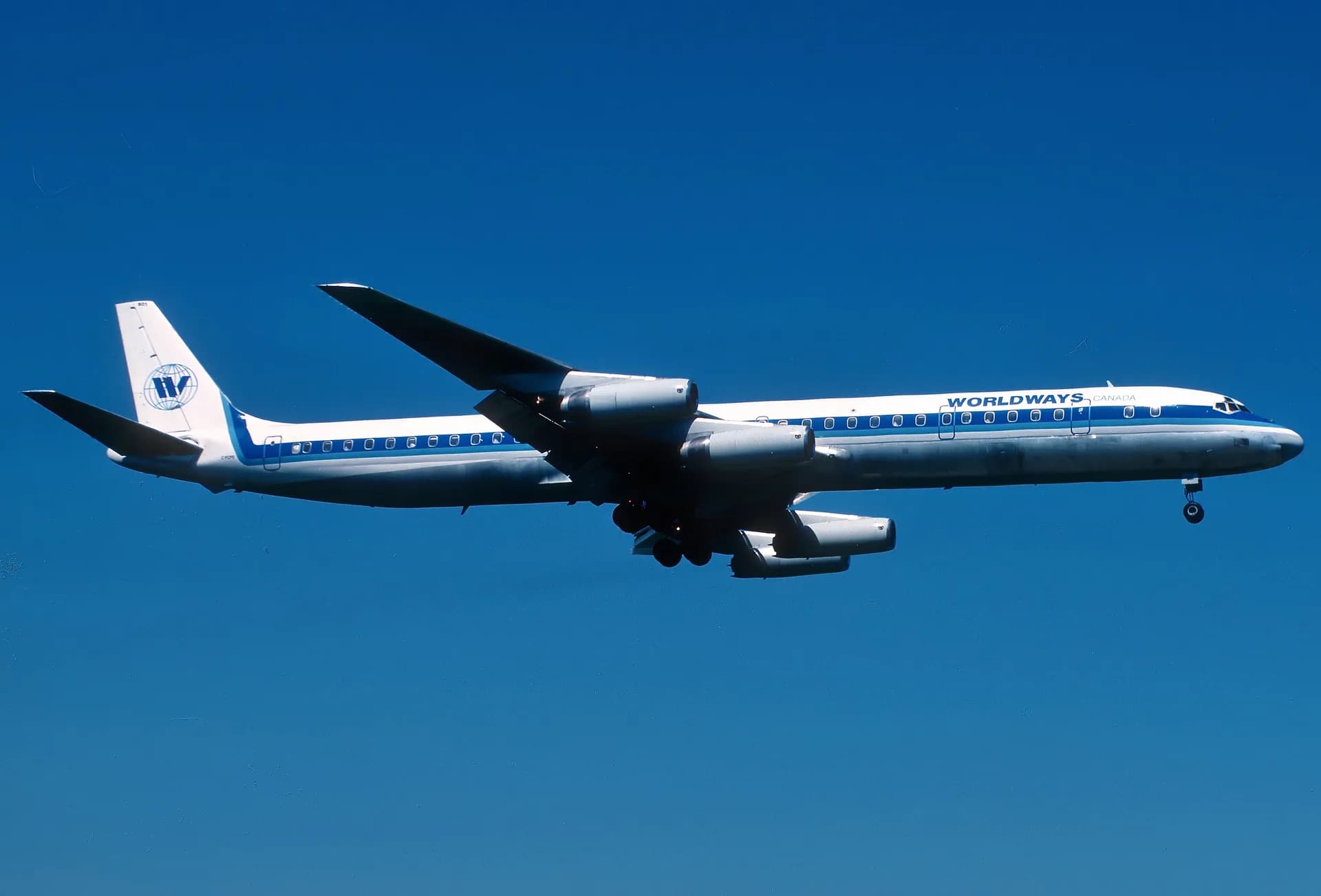
The Douglas DC-8-60 series represents a major evolution of the DC-8, featuring significant fuselage stretches to compete with the Boeing 747 on high-capacity routes. Introduced in 1967, the -60 series comprised three variants: the DC-8-61 (stretched 11.2m to 57.1m overall), DC-8-62 (long-range with increased wingspan to 45.2m), and DC-8-63 (combining both features for maximum capacity and range). The Series 63 became the benchmark variant, seating 189 passengers in typical configuration or up to 259 in high-density layouts. Powered by more powerful JT3D-3B or JT3D-7 turbofans (80.6-85.1 kN each), the -60 series offered airlines the capacity to serve growing markets without acquiring widebody aircraft. With a maximum range of 10,186 km (5,500 NM) on the -63, it served long-haul intercontinental routes. The DC-8-60 was extremely popular, with 262 built before production ended in 1972. Many were later re-engined as DC-8-70 series aircraft.
Weightscompared to Boeing 757-300
Capacitycompared to Boeing 757-300
Passenger Capacity
88% of 757-300 maximum capacity
Crew
Dimensions
Length
Wingspan
Height
Wing Area
Catalog Price
Base List Price
$8.5M USD
1969 catalog price
Note: Actual prices vary based on configuration, options, and negotiations. This represents the manufacturer's base catalog price.
Engine Specifications
Engine Count
4×
Engine Model
Pratt & Whitney JT3D-3B/7
Thrust per Engine
85.1 kN(19131 lbf)
Fuel & Cargo
Fuel Capacity
93,270 L
Cargo Volume
158 m³
Production & History
Total Produced
262
Production Status
Out of production
Manufacturing Period
1966–1972
First Flight
March 14, 1966
Entered Service
February 24, 1967
Business jets and the API are coming
If you came here for the Douglas DC-8-60, you are the reader those are being built for. Leave an address and you will hear when they are ready.