Douglas DC-8-50
Douglas/McDonnell Douglas
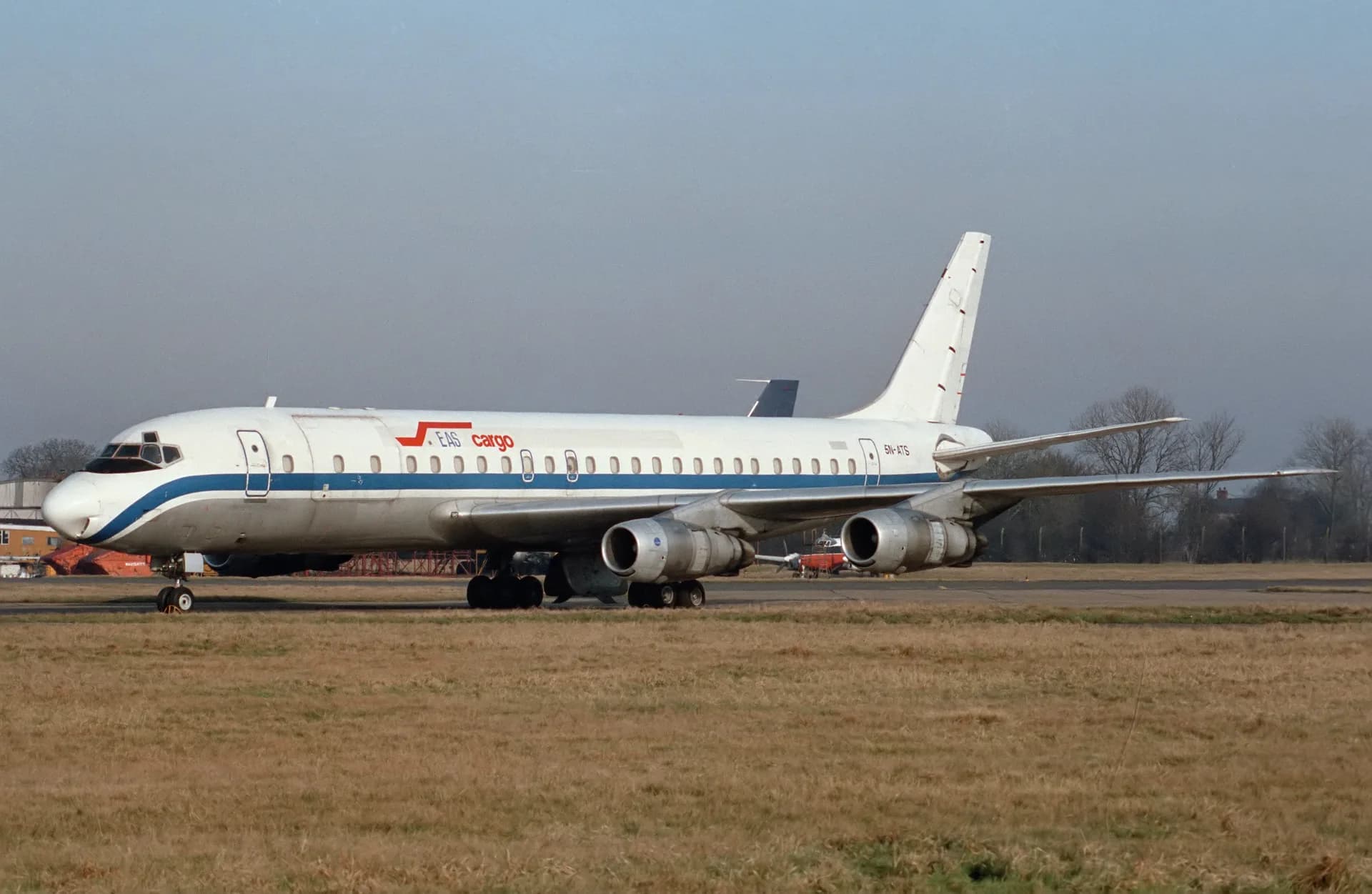
About
The Douglas DC-8-50 represents the final iteration of the original DC-8 fuselage length, featuring the most powerful turbofan engines available at launch. Introduced in 1960 with Pratt & Whitney JT3D-3 turbofans producing 80.6 kN (18,000 lbf) thrust each, it offered improved fuel efficiency and quieter operation compared to earlier turbojet-powered variants. The DC-8-50 served intercontinental routes with seating for 176 passengers in typical two-class configuration or up to 189 in high-density layouts. With a range of 9,075 km (4,900 NM), it was ideal for transatlantic and transcontinental services. The type proved popular with major carriers including Pan Am, United Airlines, and SAS. Many DC-8-50s were later converted to freighters and continue operating in cargo service today, valued for their large payload capacity and proven reliability. The DC-8-50's longevity in freight operations speaks to Douglas's robust engineering.
Weightscompared to Boeing 757-300
Capacitycompared to Boeing 757-300
Passenger Capacity
64% of 757-300 maximum capacity
Crew
Dimensions
Length
Wingspan
Height
Wing Area
Catalog Price
Base List Price
$5.5M USD
1965 catalog price
Note: Actual prices vary based on configuration, options, and negotiations. This represents the manufacturer's base catalog price.
Engine Specifications
Engine Count
4×
Engine Model
Pratt & Whitney JT3D-3
Thrust per Engine
80.6 kN(18120 lbf)
Fuel & Cargo
Fuel Capacity
83,279 L
Cargo Volume
142 m³
Production & History
Total Produced
88
Production Status
Out of production
Manufacturing Period
1960–1968
First Flight
December 20, 1960
Entered Service
April 1, 1961
Business jets and the API are coming
If you came here for the Douglas DC-8-50, you are the reader those are being built for. Leave an address and you will hear when they are ready.